Bandwidth Allocation Strategies for High-Fidelity Graphics Delivery in Cloud Gaming Services
Ellis Hughes · Oct 24, 2026
Bandwidth Allocation Strategies for High-Fidelity Graphics Delivery in Cloud Gaming Services
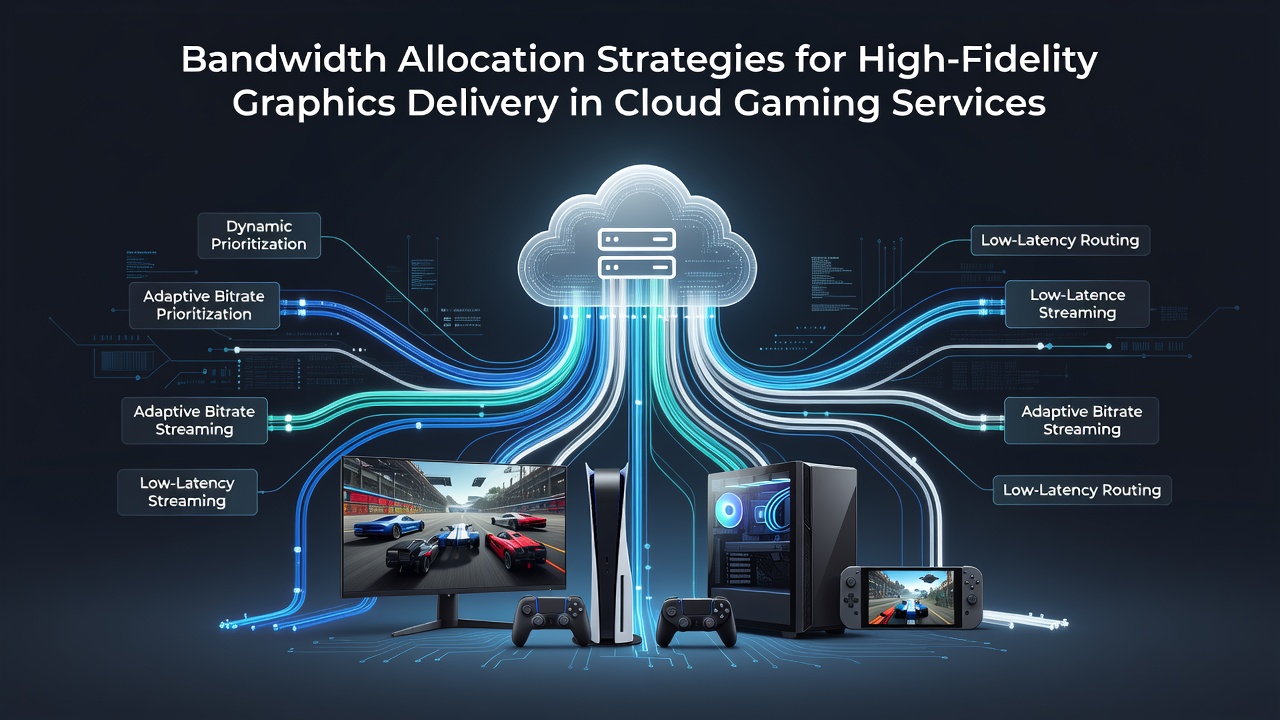
Cloud gaming platforms continue to refine how they manage network resources to deliver detailed visuals without overwhelming available connections, and bandwidth allocation plays a central role in this process. Operators assign portions of total throughput to different elements such as texture data, geometry updates, audio streams, and user input feedback, which helps maintain stable frame delivery even when multiple sessions run simultaneously on shared infrastructure.
Studies from research institutions indicate that high-fidelity graphics require sustained data rates often exceeding 50 megabits per second for 4K resolution at 60 frames per second, while newer codecs and scene complexity push those figures higher during intense sequences. Allocation systems therefore monitor real-time conditions and adjust priorities accordingly, shifting capacity toward areas where visual degradation would be most noticeable to players.
Core Techniques for Resource Distribution
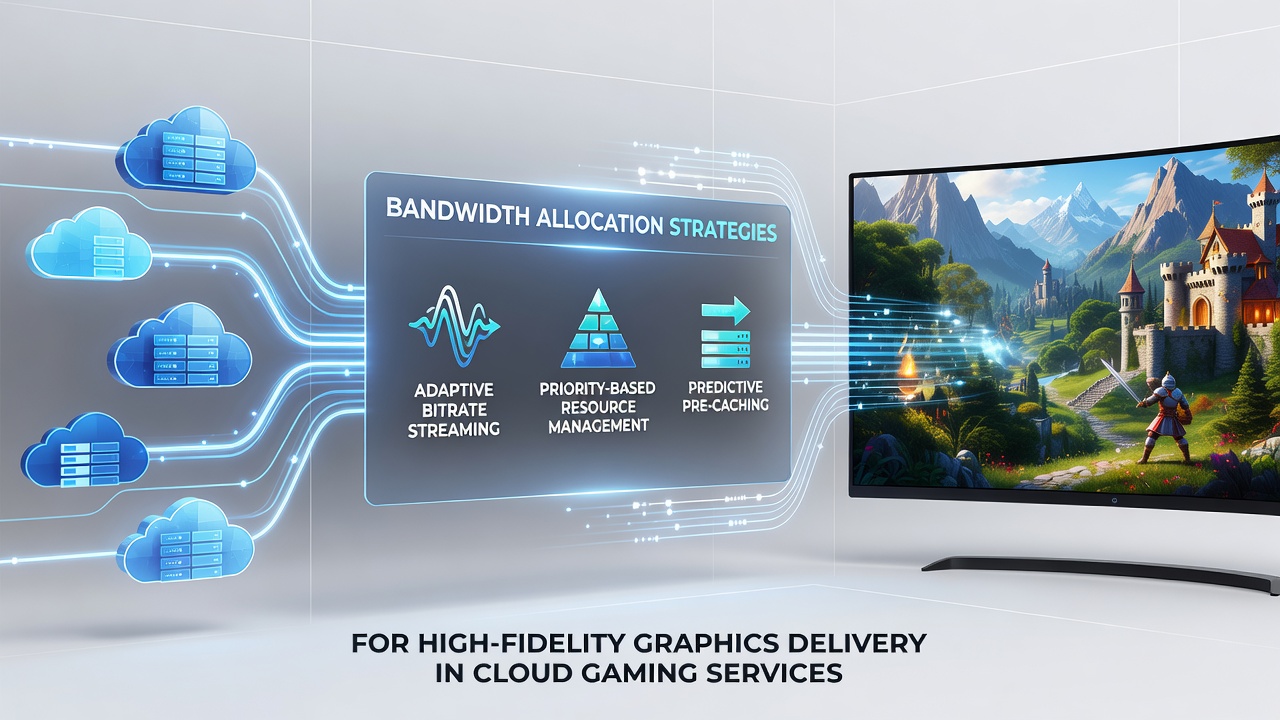
One common approach involves layered streaming, where base layers carry essential scene information and enhancement layers add finer details only when bandwidth permits. This method allows services to scale quality dynamically without interrupting the session, and researchers have documented its effectiveness in maintaining playability across variable home connections. Another technique relies on predictive pre-fetching, which anticipates upcoming visual elements based on player movement patterns and loads them ahead of time during lower-demand periods.
Tile-based encoding further refines allocation by dividing each frame into independent sections that receive different bitrates depending on their visual importance. Background elements might receive reduced data while central action zones maintain full fidelity, and this selective treatment reduces overall consumption without uniform quality loss. Observers note that such methods integrate well with existing video compression standards, including AV1 and its successors, which already incorporate tools for region-specific bitrate control.
Integration with Edge Computing and Quality of Service
Edge servers positioned closer to end users shorten transmission paths and free up core network capacity for graphics payloads, which becomes especially relevant when cloud providers expand into additional geographic regions. Data from industry reports shows latency reductions of 20 to 40 milliseconds in many deployments, yet the primary benefit for bandwidth lies in reduced packet loss and more consistent throughput. Quality of service frameworks then tag graphics packets with higher priority during congestion events, ensuring critical visual updates reach the client ahead of less time-sensitive traffic.
Allocation algorithms also account for multiple concurrent users sharing the same upstream connection, applying fair queuing rules that prevent any single session from monopolizing resources. In October 2026, several major platforms updated their orchestration layers to incorporate machine learning models trained on historical usage patterns, enabling more accurate forecasts of peak demand periods and preemptive rebalancing of available bandwidth across data centers.
Compression Advances and Adaptive Protocols
Modern encoders apply content-aware compression that distinguishes between static UI elements and rapidly changing 3D environments, assigning bits more efficiently than uniform methods. Research published through academic channels demonstrates that combining these encoders with adaptive streaming protocols such as DASH or HLS variants yields measurable improvements in perceived quality at constrained bitrates. Protocols further negotiate capabilities during session startup, selecting the most suitable codec and resolution ladder based on detected network profiles.
Those who have examined large-scale deployments point out that feedback loops between client and server play a decisive role, continuously reporting buffer status and packet arrival times so the allocator can respond within fractions of a second. When sudden spikes occur, the system may temporarily lower texture resolution or reduce draw distance before resorting to frame rate adjustments, preserving interactivity as the primary goal.
Future Directions in Allocation Research
Ongoing work explores multi-path transmission that splits graphics streams across cellular and fixed broadband links simultaneously, aggregating capacity while mitigating outages on any single route. Regulatory bodies in regions such as the European Union and Australia have begun examining spectrum policies that could support these hybrid approaches for consumer gaming traffic. Academic teams continue to publish findings on semantic compression, which transmits higher-level scene descriptions rather than raw pixel data, potentially lowering bandwidth needs by an order of magnitude once mature implementations emerge.
Conclusion
Bandwidth allocation strategies for high-fidelity graphics in cloud gaming rest on a combination of layered delivery, predictive loading, tile encoding, edge placement, and protocol-level prioritization, each validated through extensive measurement across real user bases. As networks evolve and compression techniques advance, these methods adapt in tandem to sustain visual quality under varying conditions, and the field continues to generate new data points that refine how capacity is divided among competing demands.