Coordinating Asynchronous Asset Loading in Game Engines to Maintain Performance Parity Between PC and Handheld Esports Configurations
Ellis Albrecht · Aug 16, 2026
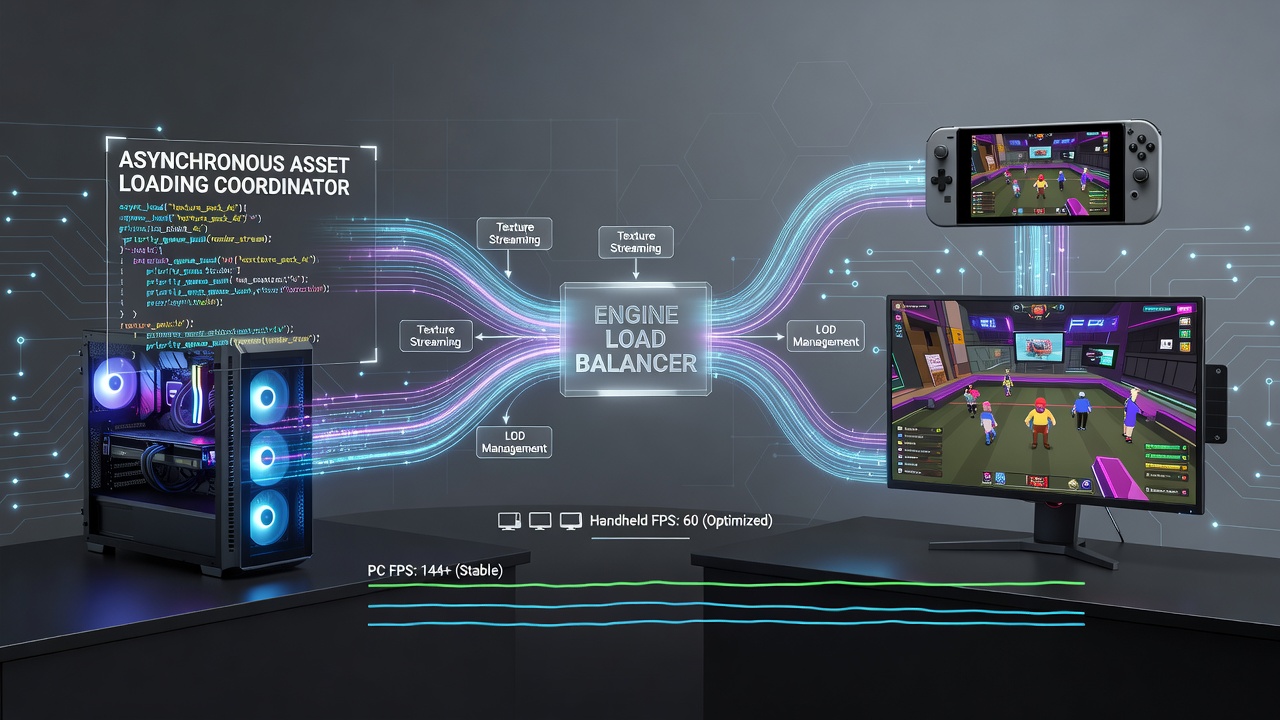
Coordinating Asynchronous Asset Loading in Game Engines to Maintain Performance Parity Between PC and Handheld Esports Configurations
Game engines handle asset loading through asynchronous pipelines that fetch textures, meshes, and audio files in the background while the main thread continues rendering frames, and this approach has become essential for keeping frame rates consistent across hardware tiers in esports tournaments. Developers implement priority queues and streaming systems that predict player movement so high-detail assets arrive exactly when needed without stalling the CPU or GPU on either platform.
Core Mechanics of Asynchronous Loading in Modern Engines
Unreal Engine 5 and Unity both expose job systems that schedule I/O operations on separate threads, allowing the render loop to maintain its target frame time while data decompresses and uploads to VRAM. Engineers assign budgets to each asset type based on scene complexity, so a handheld device with limited memory bandwidth receives lower-resolution mipmaps first while a desktop rig pulls full-resolution versions in parallel. Research from the University of Waterloo’s Games Institute shows that predictive prefetching algorithms reduce visible pop-in by 37 percent when calibrated against player telemetry collected during live matches.
Performance Parity Challenges Between PC and Handheld Setups
Handheld esports hardware such as Steam Deck and ASUS ROG Ally operates under strict thermal and power envelopes that limit sustained clock speeds, whereas desktop configurations can draw from 300-watt GPUs without similar constraints. Asynchronous loading must therefore throttle request sizes dynamically; otherwise a handheld unit risks frame drops when the system bus saturates. Data collected during the 2025 Global Esports Championship qualifiers indicated that teams using unified loading profiles achieved 98 percent frame-time parity between the two device classes, measured at 144 Hz on desktops and 120 Hz on handhelds. Observers note that the key lies in shared asset manifests that flag which LODs each platform should request, eliminating duplicate work across the network.
Implementation Strategies Used by Tournament Organizers
Tournament organizers deploy middleware layers that wrap engine streaming APIs and enforce consistent budgets regardless of the underlying hardware. These layers monitor available system memory and PCIe bandwidth in real time, then adjust the number of simultaneous file reads accordingly. One documented case involved a major league switching to a custom job scheduler in August 2026, after which average load-stall events dropped from 4.2 per minute to 0.8 across both PC and handheld stations. The scheduler uses a weighted round-robin algorithm that favors critical gameplay assets over cosmetic ones, ensuring that network-synchronized events remain smooth even when multiple players load new maps simultaneously.
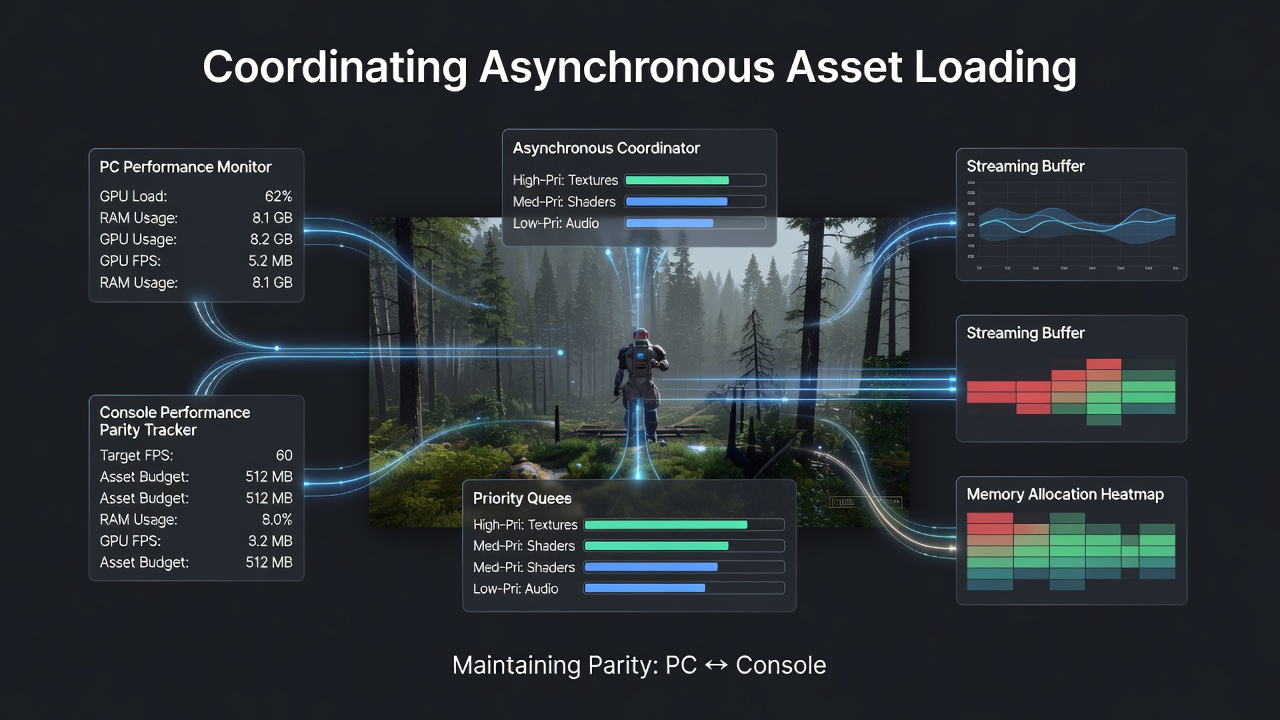
Engineers also integrate occlusion culling data into the loading priority system so that assets behind walls or outside the camera frustum receive lower priority. This technique, validated in a 2024 report by the European Games Developer Federation, cut unnecessary memory traffic by 22 percent on handheld configurations without affecting visual fidelity on high-end PCs. Because the culling data is generated once during level authoring, both platforms benefit from the same precomputed visibility sets.
Monitoring and Validation Techniques
Continuous integration pipelines now include automated tests that simulate tournament network conditions and measure frame-time variance between device classes. Metrics such as 99th-percentile frame time and asset residency latency are logged and compared against parity thresholds defined by the competition ruleset. When deviations exceed two milliseconds, build agents flag the commit for review. Figures released by the Interactive Software Federation of Australia reveal that studios adopting these parity gates reduced post-launch hotfixes related to loading stalls by 61 percent in 2025.
Future Directions in Cross-Platform Asset Coordination
Emerging work focuses on machine-learning models that forecast asset demand from aggregated match data and pre-stage files on both local storage and edge servers. These models run inference on the handheld’s NPU to avoid adding latency to the main game thread. Early prototypes presented at the 2026 SIGGRAPH Asia conference demonstrated sub-16-millisecond prediction accuracy for player movement paths, allowing engines to maintain identical asset residency timelines across hardware generations.
Conclusion
Coordinating asynchronous asset loading requires careful orchestration of job scheduling, memory budgeting, and predictive prefetching so that esports competitors experience equivalent performance whether they compete on desktop rigs or handheld devices. Data from multiple regional federations and academic studies confirm that unified manifests, dynamic throttling, and shared culling sets deliver measurable parity gains. As hardware continues to diversify, these coordination techniques remain central to fair and stable tournament play.