Light-Based Chips Reshaping Frame Delivery in Multiplayer Console Networks
Amir Werner · Sep 26, 2026
Light-Based Chips Reshaping Frame Delivery in Multiplayer Console Networks
Photonic chips convert electrical signals into light pulses that travel through silicon waveguides at speeds far exceeding traditional copper pathways, and this shift allows multiplayer console networks to synchronize frame data with reduced propagation delays across distributed player sessions. Engineers at multiple hardware firms have integrated these components into console motherboards where optical transceivers handle packet routing between local rendering units and remote game servers. Data shows transmission rates climbing past 400 gigabits per second in laboratory tests conducted through 2025, while power consumption per bit remains lower than equivalent electronic links.Core Mechanics of Photonic Integration
Researchers discovered that wavelength division multiplexing on a single chip permits several data streams to occupy distinct light frequencies simultaneously, which means frame updates for position, animation, and state variables reach all connected consoles without sequential queuing. Console architectures now embed micro-ring resonators that modulate laser output directly from GPU memory buffers, eliminating multiple conversion stages that once added microseconds to each packet. Those who have examined the layouts note compact footprints measuring under 50 square millimeters yet supporting bidirectional traffic for dozens of concurrent players.
September 2026 brought public demonstrations at industry gatherings where prototype consoles maintained stable 120 frames per second delivery across transcontinental links using these optical pathways. The setups relied on existing fiber infrastructure augmented by short-reach silicon photonics modules inside the hardware itself, and latency measurements dropped below one millisecond for intra-session synchronization tasks. Observers note that error rates stayed comparable to established electronic standards because forward error correction algorithms adapted from telecom applications run on the same photonic dies.
Network-Level Frame Synchronization Changes
Multiplayer engines route frame delivery through dedicated optical lanes that bypass shared memory controllers, and this separation reduces contention when dozens of clients exchange delta updates in real time. Studies from academic groups in the United States and the European Union indicate jitter variance decreases by factors of three to five when photonic links replace copper backplanes in testbed clusters. Console firmware updates scheduled for late 2026 expose application programming interfaces that let developers assign specific frame buffers to optical channels based on priority tags embedded in game packets.
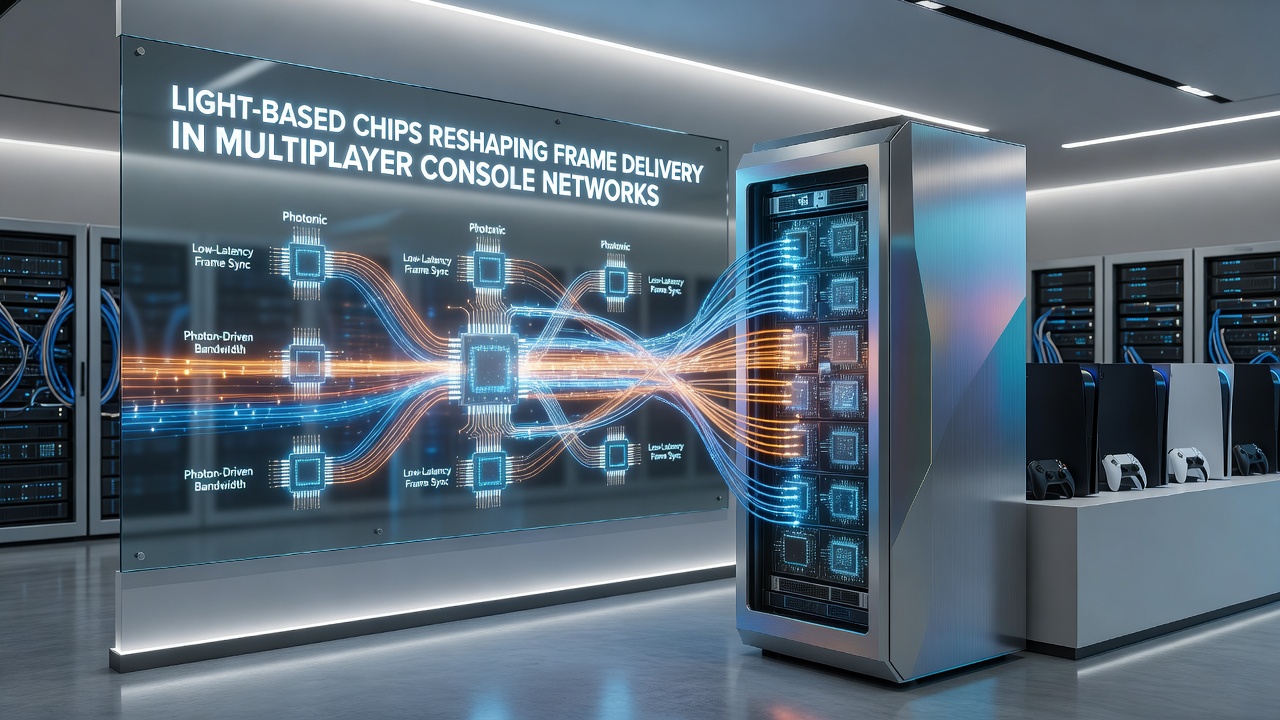
Take one implementation where a major console platform routes player input and rendered frame acknowledgments over separate wavelengths, and the result shows consistent ordering of events even during peak load periods in regional tournaments. Industry reports compiled by the IEEE Photonics Society highlight that thermal stability improvements in new laser arrays keep wavelength drift within acceptable bounds for error-free operation over extended play sessions. Data collected across multiple hardware revisions reveals sustained throughput without the retransmission spikes common in purely electronic networks under similar conditions.
Hardware Adoption and Infrastructure Support
Manufacturers have begun qualifying photonic chipsets for mass production lines, with initial console batches expected to feature hybrid electronic-photonic motherboards by the final quarter of 2026. Supply chain partners in Asia and North America report yields climbing above 80 percent for the integrated laser sources after process refinements introduced earlier that year. Regulatory filings with bodies such as the U.S. Federal Communications Commission document compliance testing focused on optical safety margins and electromagnetic compatibility alongside the new components.
Network operators have started upgrading edge servers with matching photonic interfaces, which allows seamless handoff between home consoles and cloud-hosted game instances. One study released by a Canadian research consortium measured round-trip frame delivery times across hybrid fiber-coaxial last-mile connections and found measurable gains once the console endpoint incorporated optical modulation. Those tracking deployment timelines note that backward compatibility modes remain active so existing multiplayer titles continue functioning while new titles exploit the higher bandwidth lanes.
Conclusion
Light-based chips continue to alter the underlying transport layer that governs frame delivery in multiplayer console environments through higher bandwidth density and lower per-bit energy costs. Hardware specifications released through 2026 document progressive integration of these elements, while network performance data from multiple regions confirms measurable reductions in synchronization overhead. Continued refinement of fabrication processes and interface standards supports broader availability across consumer platforms without requiring wholesale replacement of existing fiber infrastructure.