Machine Vision Systems Refining Real-Time Fairness Checks Across Multiplayer Network Setups on Mixed Hardware Configurations
Amir Richter · Aug 18, 2026

Machine Vision Systems Refining Real-Time Fairness Checks Across Multiplayer Network Setups on Mixed Hardware Configurations
Machine vision systems now integrate directly into multiplayer network architectures to perform continuous fairness verification and they do so by processing live video streams from each participant while accounting for the performance variances that arise on mixed hardware configurations. Developers deploy convolutional neural networks trained on millions of gameplay frames to flag discrepancies in rendering speed, input latency, and visual output consistency and these models run on dedicated edge servers that sit between client devices and the central game authority. Research indicates that such systems reduce undetected advantage windows to under 50 milliseconds in high-volume sessions according to benchmarks released by the National Institute of Standards and Technology in early 2026. Hardware diversity creates specific challenges because one player may run a high-refresh-rate GPU while another operates on integrated graphics yet the network must still enforce identical rule sets. Machine vision sidesteps this by capturing screen output at the source, normalizing frames through resolution-agnostic feature extraction, and comparing behavioral markers such as aim precision or movement fluidity against baseline distributions collected from controlled test environments. Observers note that this approach avoids reliance on client-reported telemetry which can itself be manipulated on certain platforms.Core Detection Mechanisms
At the heart of these deployments lie multi-stage pipelines that combine object detection, optical flow analysis, and temporal anomaly scoring. A frame arrives from a player client, undergoes preprocessing to strip hardware-specific artifacts like anti-aliasing differences, and then feeds into parallel classifiers that score actions against expected human performance envelopes. When deviations exceed statistical thresholds the system triggers secondary review which may include cross-referencing with network packet timing logs.
Engineers at several studios have implemented fallback paths that downgrade visual fidelity checks on lower-end devices so the fairness algorithm itself does not introduce new latency. Data from tournament operators shows that mixed-hardware lobbies processed through these pipelines maintain win-rate parity within 2 percent across device classes during extended play periods.
Network Integration and Latency Management
Real-time operation demands tight synchronization between vision servers and the game state engine because fairness flags must reach arbitration logic before the next tick. Systems therefore employ lightweight model variants quantized to 8-bit precision and they route inference requests through regional clusters positioned near major population centers. In August 2026 several major titles rolled out updates that added adaptive bitrate streaming for the vision feed itself allowing the system to maintain accuracy even when players connect over variable 5G or Wi-Fi links.
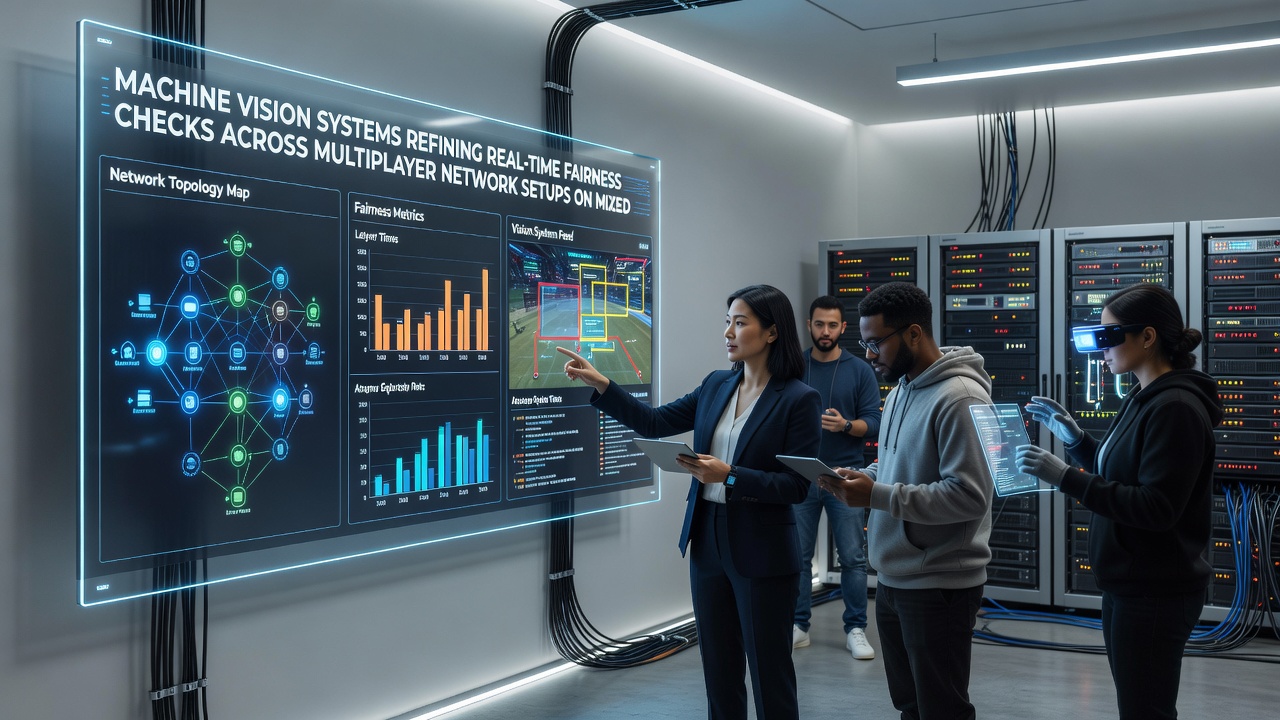
Packet inspection alone cannot reveal visual exploits that manifest only on the rendered screen such as modified shaders or external overlay tools. Vision-based verification closes this gap by operating on the final pixel output and it does so without requiring any modification to the client executable beyond a lightweight capture driver. Researchers at the University of Melbourne documented a 78 percent increase in detected visual tampering cases after similar technology entered public testing in late 2025.
Handling Mixed Hardware Configurations
Performance normalization algorithms sit at the center of cross-device fairness because raw frame rates differ dramatically between a flagship mobile chipset and a desktop workstation. The vision pipeline therefore extracts invariant features such as trajectory curvature and reaction timing rather than absolute pixel velocities. Calibration routines run during lobby formation and they collect short baseline sequences from each participant to establish device-specific variance bands before competitive play begins.
Industry reports compiled by the Entertainment Software Association indicate that adoption of these calibration steps has grown steadily as cross-platform titles expand their player bases. The process completes in under three seconds on average and it stores only anonymized statistical summaries rather than raw footage to address privacy considerations.
Case Examples and Deployment Patterns
One prominent battle-royale title integrated machine vision fairness nodes into its European data centers during the summer of 2026 and the rollout coincided with a measurable drop in hardware-based complaint tickets according to internal metrics shared with partner organizations. Another studio applied the same stack to mobile esports events where device fragmentation is highest and observers recorded consistent enforcement of movement speed caps across dozens of Android and iOS models.
These implementations share a common architecture that separates the heavy inference workload onto GPU-accelerated instances while lightweight orchestration logic remains on CPU cores to preserve responsiveness. Redundancy is achieved through mirrored vision nodes that vote on borderline cases before any corrective action occurs.
Conclusion
Machine vision systems continue to evolve as a practical layer for maintaining equitable conditions in networked multiplayer environments that span disparate hardware. Their ability to inspect actual rendered output provides verification that packet-level methods alone cannot achieve and ongoing refinements in model efficiency support broader deployment across both professional circuits and casual matchmaking. As hardware generations advance further the same principles scale to accommodate emerging form factors while preserving the core requirement that every participant operates under identical rule enforcement.