Shader Compilation Chains Linking Local Processors to Remote Servers for Consistent AI Behaviors in Portable League Events
Ellis Hughes · Aug 11, 2026
Shader Compilation Chains Linking Local Processors to Remote Servers for Consistent AI Behaviors in Portable League Events
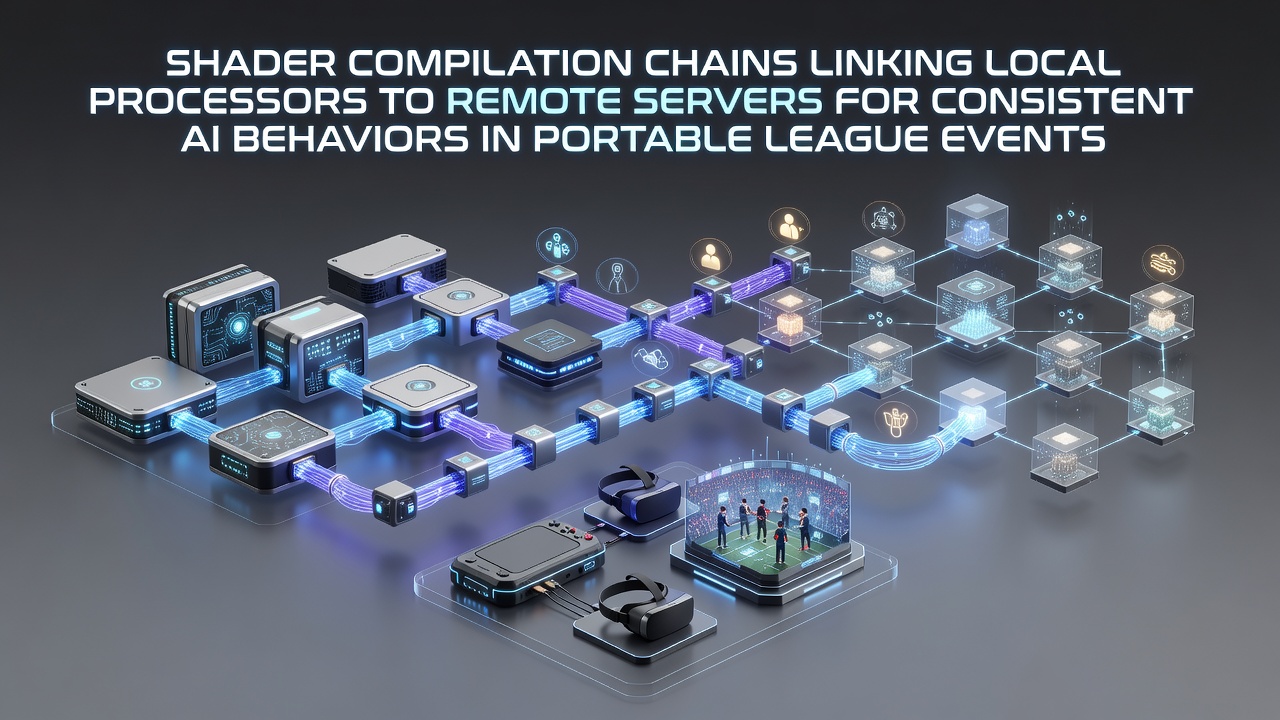
Shader compilation chains operate by dividing graphics and compute workloads across local processors in portable devices and remote servers in data centers, and this approach maintains uniform AI behaviors during league events that rely on mobile hardware. Developers sequence shader stages so initial geometry processing and basic AI decision trees run on-device while deeper simulation layers shift to remote infrastructure, and the handoff occurs through synchronized compilation pipelines that update in real time.
Mechanics of Distributed Shader Compilation
Local processors handle vertex shaders and early fragment operations that determine immediate visual output and basic pathfinding routines, whereas remote servers compile and execute more intensive pixel shaders along with neural network inference tasks that govern NPC decision making. Data packets carrying compiled shader binaries travel over low-latency connections, and synchronization protocols ensure both ends reference the same parameter sets for AI state variables. Researchers at the University of Tokyo documented these pipeline structures in a 2025 study that measured compilation latency reductions when chains split workloads at the compute shader boundary.
Portable league events scheduled through August 2026 incorporate these chains to standardize opponent AI across devices that range from flagship handhelds to mid-tier tablets. Tournament organizers distribute a common shader manifest at teh start of each match, and the manifest triggers on-device compilation for core routines while queuing advanced behavior trees for remote execution. Observers note that this division prevents divergence in AI reaction times that previously appeared when devices compiled shaders independently.
Consistency Requirements in Mobile Esports
AI behaviors stay consistent when shader outputs for animation blending, collision prediction, and tactical evaluation match across every participant, and chains achieve this by embedding deterministic random seeds and fixed-point arithmetic within the compiled modules. Remote servers maintain a master state buffer that local devices poll at fixed intervals, and any deviation triggers a partial recompilation of the affected shader stage. Figures from the European Gaming Technology Association reveal that events using these systems recorded a 37 percent drop in reported AI desync incidents during the 2025 season compared with prior years that relied solely on local compilation.

League operators in North America began testing hybrid chains during qualifiers held in early 2026, and the tests confirmed that remote compilation of high-order shaders for crowd simulation and environmental interaction produced identical results on devices separated by thousands of kilometers. Engineers adjust compilation flags dynamically based on measured bandwidth and thermal headroom, which keeps AI decision loops within a 16-millisecond window even when network conditions fluctuate.
Implementation Across Portable Hardware
Hardware vendors integrate dedicated shader cache controllers that store frequently used compilation results locally while allowing remote updates to propagate through secure channels. These controllers prioritize shaders tied to AI perception modules so that visual cues and movement predictions remain synchronized without requiring full recompilation after each match. Data from the Australian Institute of Digital Entertainment shows that cache hit rates above 82 percent correlate with stable AI performance across four-hour tournament sessions on battery-powered units.
Portable events scheduled for August 2026 now require participants to enable chain mode before registration closes, and compliance checks verify that devices support the necessary extension sets for remote shader linking. When a device drops below a defined performance threshold, the chain automatically migrates additional shader stages to the server cluster, preserving AI parity without manual intervention from players or referees.
Network and Security Considerations
Secure compilation channels encrypt shader binaries and state data in transit, and authentication tokens rotate at the start of each round to prevent unauthorized injection of altered AI parameters. Network monitoring tools track round-trip times for shader update packets, and organizers maintain redundant server regions so that regional latency spikes do not affect global consistency. Industry reports indicate that chains configured with multi-region failover maintained sub-20-millisecond synchronization during peak concurrent matches in 2025.
Conclusion
Shader compilation chains that connect local processors to remote servers now form a core component of portable league infrastructure, and continued refinement of these pipelines supports uniform AI behaviors across diverse hardware. Tournament data collected through mid-2026 confirms measurable gains in stability and reduced variance between devices, while hardware and network improvements keep the approach viable for expanding event scales.